Recipe Management: Production Cost Control for Bakeries & Restaurants
June 16, 2026
Recipe management is a POS feature that links every menu item or finished product to a digital recipe — the precise list of raw ingredients and quantities needed to produce it. When a sale or a production order is recorded, the system automatically deducts each ingredient from stock and updates the real food cost, expected yield and margin in the background. The operator no longer needs to ask "how much did we sell" — the POS already shows "how much did we actually make."
How Recipe Management Works: From Ingredient to Sale
Recipe management is one layer above classic stock control. In classic stock, every product is a single card: "I bought 100 loaves, sold 80, 20 left." But in a production business, the product sold is not the product purchased. When a loaf of bread is sold, what should leave stock is flour, yeast, salt and water — not "bread." That is exactly where the recipe takes over.
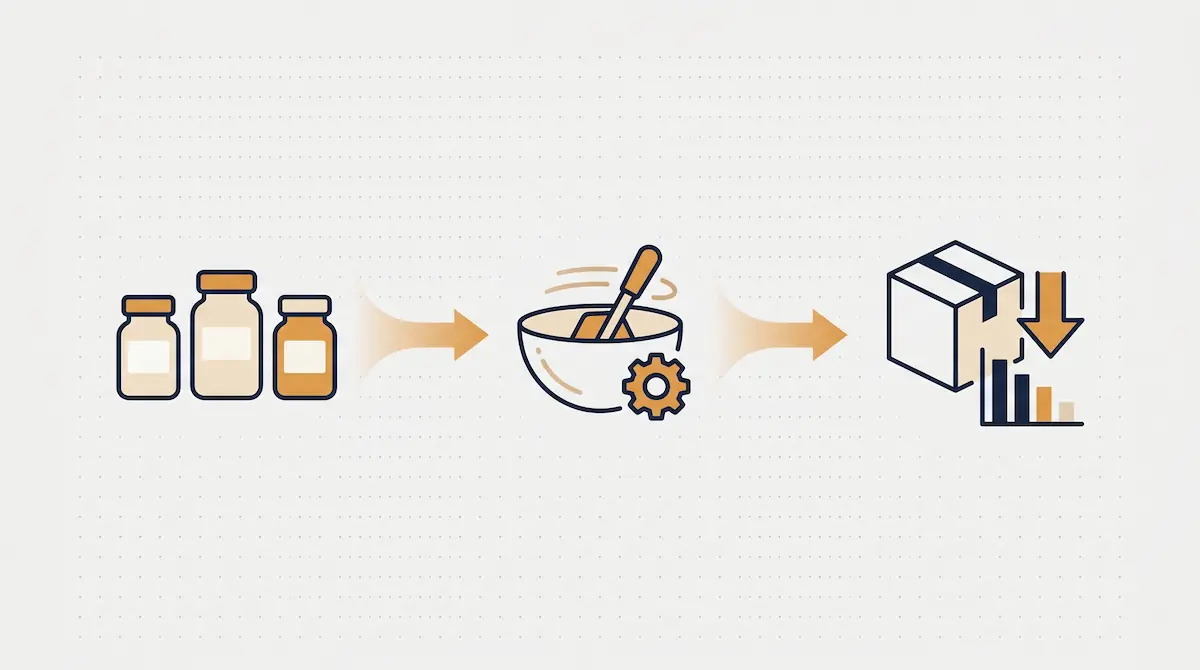
The Recipe Card: a Product's Digital Blueprint
Every finished product gets a recipe card in the POS. At a minimum it carries:
The product's own SKU and name (for example "white sourdough loaf, 400 g").
The yield — how many units or what total weight the recipe produces in one batch.
The list of raw ingredients and the exact net quantity of each (350 g flour, 7 g salt, 5 g yeast…).
A waste/loss allowance — the expected loss percentage during baking, cooling, slicing or service.
Optional labour and energy parameters — minutes per unit and kWh per batch, if you want them in the cost model.
A well-built recipe runs across thousands of sales without drift. That is why the setup phase is the most critical step in recipe management; a recipe entered with the wrong gram weight will surface months later as a stock variance or a margin gap.
Production Orders vs. Sale-Time Deductions
A POS that supports recipes typically runs two modes side by side. The first is the production order flow: a manager creates an order for 100 loaves at the start of the shift, the system instantly deducts 35 kg of flour, 700 g of salt and 500 g of yeast from stock and adds 100 loaves to finished-goods stock. The loaves then sell as individual SKUs.
The second is the sale-time flow: in a restaurant or café there is no pre-production, the product is built when the order arrives. When the guest orders a chicken salad, the POS doesn't just record the sale — it reads the recipe and deducts 120 g of chicken breast, 80 g of lettuce and 30 g of dressing from raw stock in the same second. Daily consumption reports update live.
Mixing the Two Modes
Most production businesses use both. Bakeries lean on production orders because product is made in advance and goes to the display. Restaurants and cafés lean on sale-time deduction because each dish is built to order. Caterers run both at once — bulk production orders for event meals plus à la carte deductions for the on-site service.
Who Needs Recipe Management Most?
Recipe management is not essential for a simple retailer who buys and resells the same SKU. But the moment a business turns one ingredient into a different product, no recipe means no real visibility into cost, yield or margin.
Restaurants and Cafés
Picture a restaurant with 60 menu items and an average of 8–10 ingredients each. Without a recipe system the chef ends up doing rough end-of-day deductions and the variance compounds — by month-end there is unexplained shrinkage in proteins, vegetables and disposables. With recipe-based deduction, every plate sold deducts ingredients automatically, so stock variance only reflects real waste and real errors, not paperwork drift.
In cafés, high-frequency ingredients (milk, beans, syrup, cups) make recipes especially valuable. Once a latte is defined as 200 ml milk, 18 g beans and 1 cup, end-of-day reports tell you exactly how much you consumed by the gram and how many days of stock you have left.
Bakeries, Patisseries and Chocolate Workshops
In bakeries and patisseries, recipe management matters twice as much because the same ingredient (flour, butter, sugar) is transformed into dozens of finished items: loaves, croissants, brioches, cakes. Without recipes, "we used 80 kg of flour today, but which products did it go into?" is unanswerable.
With recipe management each product has its own recipe, and the end-of-day report shows finished-goods output mapped against ingredient consumption. For patisseries and chocolate workshops, the same structure also gives traceability on premium ingredients — cocoa, nuts, artisan creams — that disproportionately drive cost.
Catering and Bulk Meal Services
Catering is where recipe management earns its keep daily. When a corporate client orders "500 lunches — main, side, salad, dessert," the operation has to know its total ingredient list and total cost in minutes. A caterer without recipes does that math by hand every time; the error margin is high and the quoting process is slow.
A recipe-based POS scales a recipe to "500 portions" with one tap and returns the full ingredient sheet, the waste allowance and the projected cost. Quotes go out faster and at a margin that is actually defensible.
Portion Control: The "Same Taste Every Time" Promise
The value of a recipe isn't only financial — it also locks in product consistency. A burger that has 150 g of beef today, 180 g tomorrow and 130 g the day after tells customers "this is not the same place." Once the recipe is in the POS, portion sizes stop drifting, and a new line cook can produce the same dish on day one by reading the card on screen.
Portion control delivers three concrete wins:
Consistent customer experience: Every plate looks and tastes the same. This is the basis of brand trust in food.
Catching over-portioning early: If the recipe says 120 g of cheese but the line is plating 180 g, the POS surfaces the variance between expected and actual stock and you can intervene before a month of margin disappears.
Faster staff onboarding: The recipe card becomes a training aid. New staff see the gram weight on screen instead of asking a senior chef — a real advantage in an industry with high turnover.
Recipe-Based Cost Analysis (Food Cost)
The most tangible business value of recipe management is food cost analysis. Food cost is the ratio of the total cost of producing a dish to its selling price, and it is the single most important number a restaurant or bakery owner can track.

Ingredient, Labour and Energy
A modern recipe system goes beyond raw ingredient cost and pulls in every cost line that touches production:
Ingredient cost: Each component multiplied by its current purchase price. When a supplier price changes, all linked recipes update automatically.
Labour cost: Average prep time per unit multiplied by the hourly cost of the production team. A bread roll might be 30 seconds; a layered cake 45 minutes — the gap shows clearly in the cost picture.
Energy cost: Average oven, fridge and equipment consumption can be allocated per batch. For bakeries especially, where ovens run for hours, baking energy is a meaningful slice of the real cost.
Add the three lines together and you see the true production cost of a plate or a loaf. Subtract that from the menu price and you get the real per-unit margin. Because the POS does this on every sale, owners do not wait for month-end to know which items earn money and which ones quietly lose it.
Food Cost Percentage and Healthy Ranges
Food cost percentage is ingredient cost divided by selling price. Healthy ranges vary by business model: a café typically sits at 20–25%, a casual restaurant at 28–35%, fine dining at 35–40%. Bakeries and patisseries usually fall in the 30–40% band, with high-margin coffee or low-margin staples pulling the average around.
A recipe-based POS publishes live food cost % per item. When a supplier raises a price, the percentage moves and the system flags it. From there, price increases, recipe substitutions or portion adjustments become data-driven decisions rather than gut calls.
Waste and Loss Tracking
Recipe management only stays accurate when waste is recorded with discipline. No kitchen or bakery converts ingredients with 100% yield — baking loss, trim, spoilage and service errors are part of every operation.
Each recipe card carries a standard waste percentage. A kilo of chicken breast might be defined with a 12% prep loss; a kilo of dough with a 4% baking loss. The POS deducts ingredients accordingly so expected stock matches reality more closely.
Beyond standard loss, unplanned waste needs its own log:
Production failure: burned batch, ruined dough, failed bake.
Expiry / spoilage: a tray of pastries left in the cabinet past shelf life.
Service error: wrong dish sent out and returned.
Staff consumption: valuable to record so it doesn't show up as mystery shrinkage.
Each unplanned waste event is logged with a reason code, and the end-of-month report shows where the loss really goes. The gap between expected and actual waste is also a quality signal for the recipe itself — a persistently high gap means either the recipe's loss allowance is too low or there is genuine operational waste worth investigating.
Creating Production Orders from the POS
For bakeries and patisseries, the day starts by raising a production order. A recipe-based POS turns that ritual into a single-screen workflow.
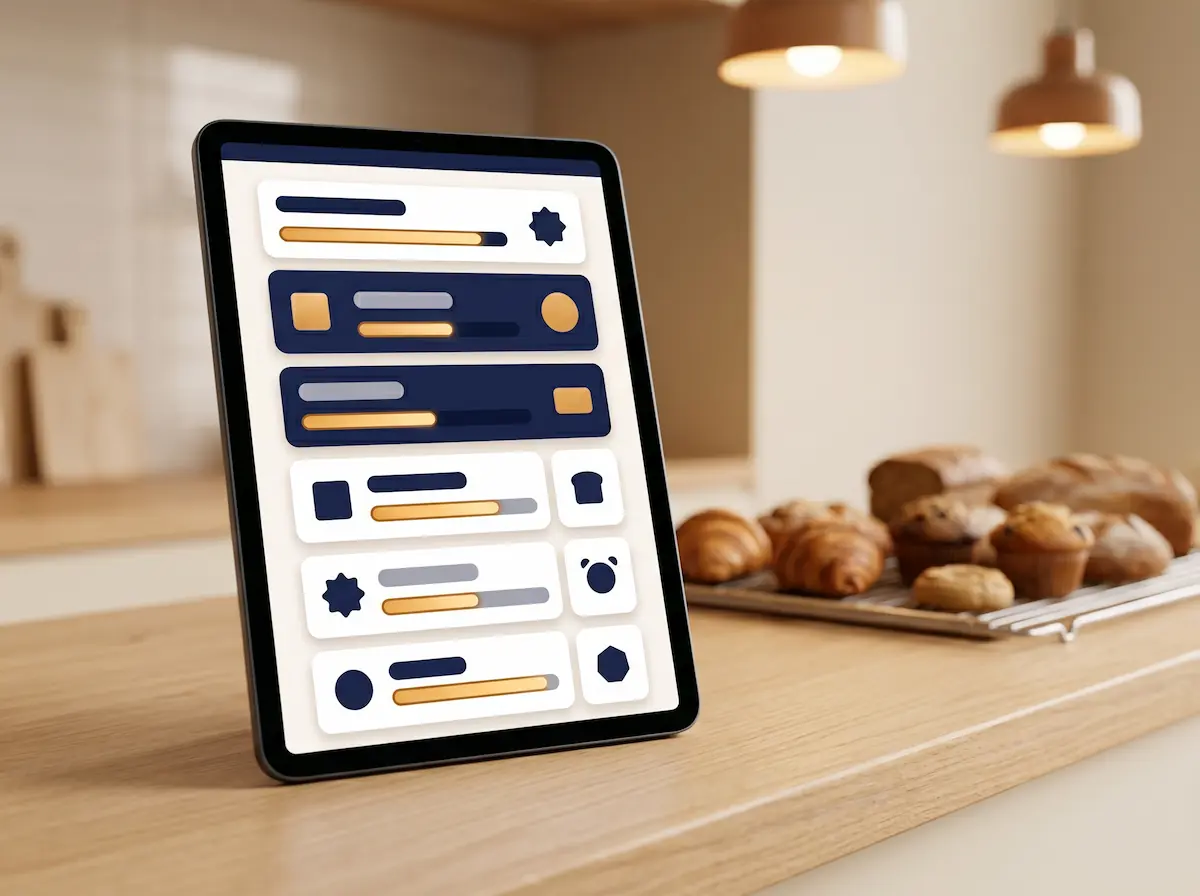
A typical production order runs through these steps:
Choose product and quantity. The production lead picks the finished item and how many units or kilos to make. The POS reads the recipe and calculates the total raw ingredient demand.
Check availability. The system shows whether each ingredient is in stock at the required quantity. Shortfalls trigger a warning and can be added directly to a purchase suggestion list.
Release the order. Approved orders move ingredients to a "reserved" state, deducting from raw stock. The kitchen or bake team sees the list on their own screen.
Record actual yield. When production is finished, the real output is entered. If the recipe planned 100 loaves but 97 came out, the system logs the missing three as a waste line automatically.
Push to finished-goods stock. The output enters the sellable catalogue and is ready at the counter.
The same flow makes shift handover easier. The evening team sees pending production orders, the morning team compares planned vs. actual on the same screen, and all the data lives in one place.
Common Pitfalls in Recipe Management
The businesses that get real value out of recipe management and the ones that "have it installed" are usually separated by a handful of preventable mistakes:
Not refreshing ingredient prices. When supplier prices climb but recipes still cost ingredients at the old rate, reported food cost no longer reflects reality. A monthly price refresh is a non-negotiable habit.
Setting waste to zero. Zero waste is a fantasy. Without a realistic allowance, stock variance becomes chronic.
Setting recipes once and forgetting them. Menus evolve, suppliers change, portion strategy shifts — recipes need maintenance like any other business asset.
No sub-recipes. Sauces, doughs and fillings used in several products should be modelled as sub-recipes. Otherwise every parent recipe grows unwieldy and updates are inconsistent.
Skipping staff training. A recipe system is only as good as the team's discipline. If the line plates by feel, the recipe data drifts away from reality.
Frequently Asked Questions
What is the difference between a recipe and a menu item?
A menu item is what the guest sees and orders. A recipe is the digital blueprint behind that item — the exact ingredients and grams used to make it. The guest orders "chicken wrap"; the POS reads the recipe and deducts chicken, flatbread, sauce and salad from raw stock.
Is recipe management overkill for a small café?
No, the value usually shows faster in small operations. In a five-seat café, high-frequency ingredients like milk, beans and cups account for most of the cost, and recipe tracking shifts cost control from a weekly Excel chore to a live dashboard on the owner's phone.
How often should recipes be updated?
Ingredient prices should be refreshed at least monthly; recipe contents should be updated whenever the menu, supplier or portion strategy changes. Seasonal menus deserve a full review at the start of each season.
How do sub-recipes work?
A sub-recipe is a building block — a sauce, dough or filling — that is used in multiple finished products. It gets its own ingredient recipe, and parent recipes simply include "200 g of pizza dough" as if it were a single ingredient. One update to the sub-recipe flows through to every dish that uses it.
Recipe Management with Kardo POS
In Kardo POS, recipe management is not an add-on module — it sits inside the core POS. The kitchen line, the till and the stock room run on the same data, so once you set up your recipes the sales-to-stock deduction, food cost calculation and waste reporting all happen in the background.
If you run a restaurant, café, bakery, patisserie or catering operation and want to see how recipe management would behave in your business, the Kardo POS demo walks through real scenarios end-to-end. Our goal is to turn the recipe from a setup task you forget about into a daily decision tool you actually look at.